
Originally published: October 2025 | Updated: December 2025 | Reviewed by Mary Conte
Florida homeowners often encounter confusing paperwork when they get married, get divorced, or need to update their property records. These requirements slow down real estate deals.
An Affidavit of Continuous Marriage proves an unbroken marriage between spouses who co-own property. Name changes in the title need careful steps to keep property records accurate.
Property held by married couples in Florida is usually classified as tenancy by the entirety. That status gives special legal protections and survivorship rights.
Still, title insurance companies and buyers want proof that the marriage remained continuous the whole time the couple owned the property.
Getting these details right can save thousands in legal fees and prevent headaches at closing. Changing names on property title deeds requires precision and adherence to the proper legal steps.

A continuous marriage affidavit is a legal document that states that property was acquired during the marriage and that the couple remained married continuously up to the date of sale or a spouse’s death. This affidavit confirms that the marriage remained valid and directly affects property ownership rights.
When a spouse dies in Florida, the surviving spouse has to clear the property title before any future transactions. Florida couples typically hold property as tenants by the entirety, which grants automatic survivorship rights.
Therefore, when one spouse passes away, their interest automatically transfers to the surviving spouse. Still, title companies want proof that this transfer happened legally.
The affidavit of continuous marriage acts as that proof. It confirms the couple was married when they bought the property and stayed married until death.
Without this affidavit, buyers or lenders may doubt the surviving spouse’s ownership. The document clears up any confusion about the property’s history.
Title insurance companies request the affidavit, even though Florida law doesn’t strictly require it. They want to protect themselves and future buyers from legal problems.
The affidavit lets title companies issue clean insurance policies. Without it, they risk claims about ownership disputes.
Most title companies won’t process sales or refinances involving a deceased spouse unless they get this document. They see it as basic protection against future issues.
The surviving spouse files this affidavit with the County Clerk, making a public record of the continuous marriage.
Every continuous marriage affidavit needs some specific details. The legal property description must appear in the document.
Essential components include:
The affidavit must state under oath that the marriage remained continuous and valid. The surviving spouse swears, under penalty of perjury, that the information is true.
A notary public must witness the signature for the affidavit to count. The notary checks the signer’s identity.
Some affidavits also list both spouses’ Social Security numbers for extra identification.
Florida homeowners need the affidavit primarily when one spouse dies and the surviving spouse wants to remove the deceased spouse’s name from the title while preserving rights and insurance.
Married couples in Florida usually hold property as tenants by the entirety if both names are on the deed. This arrangement gives survivorship rights.
When one spouse dies, their share passes automatically to the surviving spouse. Still, clearing the title after a spouse’s death needs proof of continuous marriage.
The affidavit shows the couple stayed married from the property purchase until the spouse’s death. This prevents title disputes and confirms clear ownership.
Common situations requiring the affidavit:
Title companies require continuous marriage affidavits before issuing policies on property that belonged to both spouses. The document confirms the surviving spouse’s rights and clears the title for sale.
Refinancing triggers a title review. Lenders typically require proof that the surviving spouse owns the property before approving new loans.
Real estate sales can become complicated without the proper paperwork. Buyers and their title companies want to see that the seller actually owns the place.
Key transaction requirements:
The affidavit streamlines the transfer process and alleviates concerns about property ownership.
If you’re ready to get started, call us now!
Homeowners must decide whether to update the deed with their current name or retain the old one. Name changes after marriage or divorce can cause title headaches.
If the deed has an old name, the continuous marriage affidavit can connect the old and new identities. That way, you don’t always need a new deed.
Sometimes, keeping the original name on the deed makes later transactions easier. However, if the name change is significant, you may need additional documents for sales or refinancing.
Factors affecting the decision:
The affidavit bridges the gap between different names and maintains a clear ownership record.
To get your new name on the property title, first legally change it in court under Florida Statutes § 68.07, then update your deed/title by submitting corrected documents to the county clerk.
If you want a legal name change in Florida, you’ll need to file a petition with the local circuit court. You must be at least 18 and a Florida resident.
Required Forms and Documentation:
The law requires you to undergo fingerprinting and a background check as part of the process. You must visit an approved fingerprinting location before filing.
Court Process Steps:
Miami-Dade residents must file in their own county and demonstrate that they actually reside there. The judge will review the petition and determine if the name change is appropriate.
Once the court approves the name change, you need to update your ID documents. This step matters for property transactions.
Priority Document Updates:
The name change process involves updating several agencies, and you should begin with the Social Security Administration. Other agencies often require a new Social Security card first.
Required Documentation for Updates:
Banks, mortgage companies, and insurance providers also need to know about the name change. Property owners should contact their homeowners’ insurance provider and mortgage servicer promptly after the change.
Florida recording offices adhere strictly to rules when it comes to accepting name changes on property deeds.
Property title changes require specific legal documentation before clerks will record new deeds.
Acceptable Proof Documents:
Recording a new deed requires photo identification and notarization. All property owners must sign the new deed in the presence of witnesses and a notary public.
Recording Process Requirements:
County clerks check that the documentation matches before accepting the deed for recording.
Property owners should bring multiple certified copies of their court order, as recording offices typically retain the original documents.
From affidavits to court-approved name changes, Mary Conte Law makes the process simple and stress-free. Protect your home’s title and your family’s future—contact us now to schedule.
If you’re ready to get started, call us now!
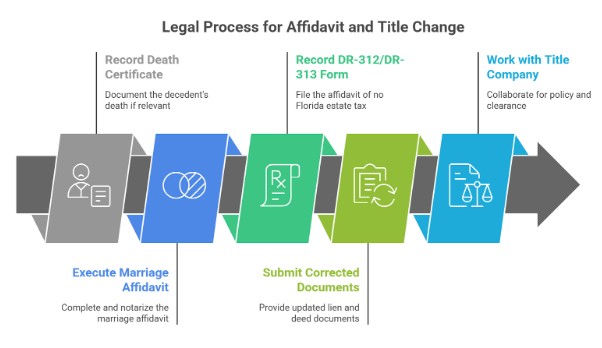
Recording an affidavit of continuous marriage and changing a name on the title requires specific documents to be filed with the county clerk.
The process involves several steps, including obtaining death certificates, completing notarized affidavits, filing tax forms, and collaborating with title companies.
If a spouse passes away, the first step in clearing title to real property is to record a certified copy of the death certificate. File this document with the Clerk of Court in the county where the property sits.
The death certificate proves the spouse’s passing and establishes the date of death. It also confirms the surviving spouse’s status.
Required Information:
The clerk stamps and records the certificate in the public records. Title companies and future buyers can reference this official record.
The surviving spouse fills out and signs an affidavit of continuous marriage before a notary public. This document confirms that the marriage stayed valid from the wedding date until the spouse’s death.
Florida procedures require an additional step beyond simply recording the death certificate. The affidavit helps title insurance companies verify the surviving spouse’s rights.
Key Requirements:
The notary public checks the signer’s identity and witnesses the signature. The completed affidavit gets recorded with the county clerk alongside the death certificate.
Property owners need to file Form DR-312 or DR-313 to show no Florida estate tax is owed. This form is required when selling or transferring property after the death of a spouse.
The DR-312 form covers most residential properties and states that the estate value falls below the Florida estate tax threshold.
Form Details:
The clerk records this form with the other documents. It becomes part of the permanent property record and satisfies state tax requirements.
New deed documents must accurately reflect the correct name and ownership status. Whenever owners make changes to the property title, they must record updated deeds with the county.
The new deed takes the deceased spouse’s name off and shows a clear title in the surviving spouse. It might also fix name variations or spelling errors.
Document Requirements:
Outstanding liens or mortgages might need updated documentation. Lenders typically require death certificates and marriage affidavits to update their records.
Title companies review all recorded documents before issuing new insurance policies. The affidavit allows title insurance companies to insure property when the surviving spouse sells or refinance.
The underwriter looks over the death certificate, marriage affidavit, and tax forms. They check if the documents meet legal requirements and clearly establish ownership.
Title Company Services:
The title company collaborates with the county clerk to ensure that all documents are recorded accurately. They keep copies of all documents for their files and future reference.
Several issues can hinder the affidavit of continuous marriage process or complicate name changes on property titles.
These problems often involve documentation requirements, existing liens, recording mistakes, and different procedures across Florida counties.
Title insurance companies have strict standards for affidavits of continuous marriage. They may reject documents that don’t meet their formatting requirements or lack complete information.
Common rejection reasons include:
Some insurers want extra documentation beyond the standard affidavit. They may request marriage certificates, death certificates, or even supplemental affidavits to address specific title concerns.
Property owners should contact their title company before preparing the affidavit. That move can prevent costly delays and ensure the document meets insurer standards from the start.
Existing liens complicate the continuous marriage affidavit process. Mortgages, judgments, and tax liens on the property add extra requirements for clearing title.
Mortgage lenders usually want formal notification when ownership changes.
Even though the continuous marriage affidavit doesn’t technically transfer ownership, lenders may still demand loan assumption procedures or payoff.
Liens that commonly interfere include:
Property owners must address these issues before recording the affidavit. Some liens require separate legal steps to be removed or transferred to the surviving spouse’s name.
Errors in property descriptions or names can cause significant title issues and incur substantial costs to rectify. Common mistakes with property deeds include misspelled names and wrong legal descriptions.
Frequent naming errors:
Legal description mistakes often happen when copying from old deeds or surveys. Even small errors in lot numbers, subdivision names, or metes and bounds can mess up the document.
Getting a professional to review the paperwork can prevent these headaches. Many property owners hire attorneys or title professionals to review and verify everything before recording.
Florida counties don’t all play by the same rules for recording affidavits and deed documents. Some enforce stricter requirements that go beyond state minimums.
Miami-Dade County requires additional certifications for certain affidavits. Broward County has specific formatting requirements for property descriptions that differ from those in other areas.
Orange County sometimes wants supplemental documentation for properties with complicated ownership histories. Pinellas County enforces stricter notarization rules than many other places.
It’s always a good idea for property owners to check with the county clerk’s office before preparing documents. Each county offers its own guidance on local recording requirements and acceptable formats.
Some counties charge higher recording fees for corrected or resubmitted documents. Knowing the local rules up front can save you from extra trips to the courthouse and unexpected costs.
Correcting property documents or updating a title after a marriage or name change is more than just paperwork — it’s about protecting your family’s rights for the future. At Mary Conte Law, we make the process clear, efficient, and stress-free.
We are familiar with Seminole County’s recording requirements inside and out, and we guide you step by step to ensure nothing is overlooked.
Whether you’re preparing an Affidavit of Continuous Marriage, recording a corrective deed, or completing a name change update, our team ensures your documents meet Florida’s legal standards and title company expectations.
Clients choose us because we combine precise legal work with compassionate service. You’ll always know what to expect, when to expect it, and how your property is being protected.
Wayne Woodis – “Outstanding Living Trust Services. We recently worked with Mary Conte and her team to set up our living trust, and couldn’t be happier with the outcome.”
Edna VH – “I had a wonderful experience with Mary Conte Law. Mary made creating my estate will simple, clear, and stress-free. I feel confident and at peace knowing my affairs are in order.”
Ossie Calara – “Estate Planning involves more than just creating a WILL. We cannot ask for more after meeting Attorney Mary Conte Mollenhauer. She helped us with everything we needed.”
Anonymous – “The location was convenient, and the office was clean and well-maintained.”
Anonymous – “Mary is very thorough and has excellent communication and follow-up skills.”
Florida homeowners deal with some pretty specific legal hoops when it comes to property titles after getting married—or after a spouse passes away.
The continuous marriage affidavit helps establish an uninterrupted marriage up until the death of one spouse.
If you’re a property owner, you’ve got to know that changing names on deeds requires precision. One small mistake can turn into a headache (and a bill) down the road.
The affidavit plays a big role in Florida real estate deals. It allows title insurance companies to insure property when the surviving spouse wishes to sell or transfer it.
Homeowners really need to prepare these documents with care. Florida law imposes penalties for false statements in legal affidavits, so it’s not something to take lightly.
Working with experienced title professionals makes sense. They know Florida’s requirements inside and out and can steer you through all the paperwork.
Property rights hinge on getting the documentation right. Take your time—it’s worth it for your peace of mind and for any future transactions.
Don’t leave your property rights to chance. Mary Conte Law ensures your affidavits and deed changes are handled correctly the first time. Secure peace of mind—contact us today to schedule.
What is an Affidavit of Continuous Marriage in Florida?
An Affidavit of Continuous Marriage is a sworn statement confirming that spouses were continuously married from the time they acquired property until the death of one spouse. It’s used to clear title and reassure title companies.
When is a continuous marriage affidavit required?
It’s commonly required when a surviving spouse wants to remove a deceased spouse from the property title or when refinancing or selling Florida real estate.
Does Florida law mandate the affidavit?
Florida law doesn’t always require it, but many title insurers and clerks request it to protect against disputes and ensure a clear title.
Do I need to change my name on the property title after marriage?
No, it’s not legally required. However, updating the deed for consistency can prevent confusion with lenders, title companies, or during the probate process.
How do I legally change my name in Florida?
You must file a petition in circuit court under Florida Statute § 68.07, complete background checks, and obtain a court order before updating titles and other records.
Can I file the affidavit or deed change myself?
Yes, you can, but errors often lead to rejections. Having an attorney ensures the affidavit and deed updates meet legal and title company standards.
What if the property has a mortgage or lien?
You can still update names or file affidavits, but lenders may have additional requirements. It’s best to notify them early in the process.
How long does it take to update a title with a new name?
Recording usually takes a few business days once documents are accepted. If court petitions or title company reviews are involved, it can take several weeks.
Latest Post

December 16 2025
How to Open a Probate Estate in Seminole County After a Death: Forms, Steps, and Who Files What
To open a probate estate in Seminole County, families file a petition with the Seminole County...

December 16 2025
When someone passes away in Seminole County, their family often faces probate to settle the...

November 21 2025
Recording a deed in Seminole County can feel confusing. The process involves fees, paperwork, and...

